
Recent public discussion of weaknesses in AI-agent workflows has put a useful question in front of enterprise leaders: what happens when a capable model is allowed to read information, call tools, and take action across real systems? The issue is not limited to one provider or one reported incident. Any agent can be influenced by untrusted content, given more authority than its task requires, or operate without a reliable way to show what it used and why. The risk rises when agents are connected directly to email, documents, browsers, customer records, or operational systems.
A governed path to action
For Neurovians, the response is to treat an agent as a governed worker—not a chat interface with a list of integrations. Every agent should have a defined purpose, a limited set of approved tools, an explicit data boundary, and a clear escalation path to a person. Its actions should be permission-aware, logged, and evaluated against a task-specific standard before autonomy expands. This turns security from a final review into part of the operating design.
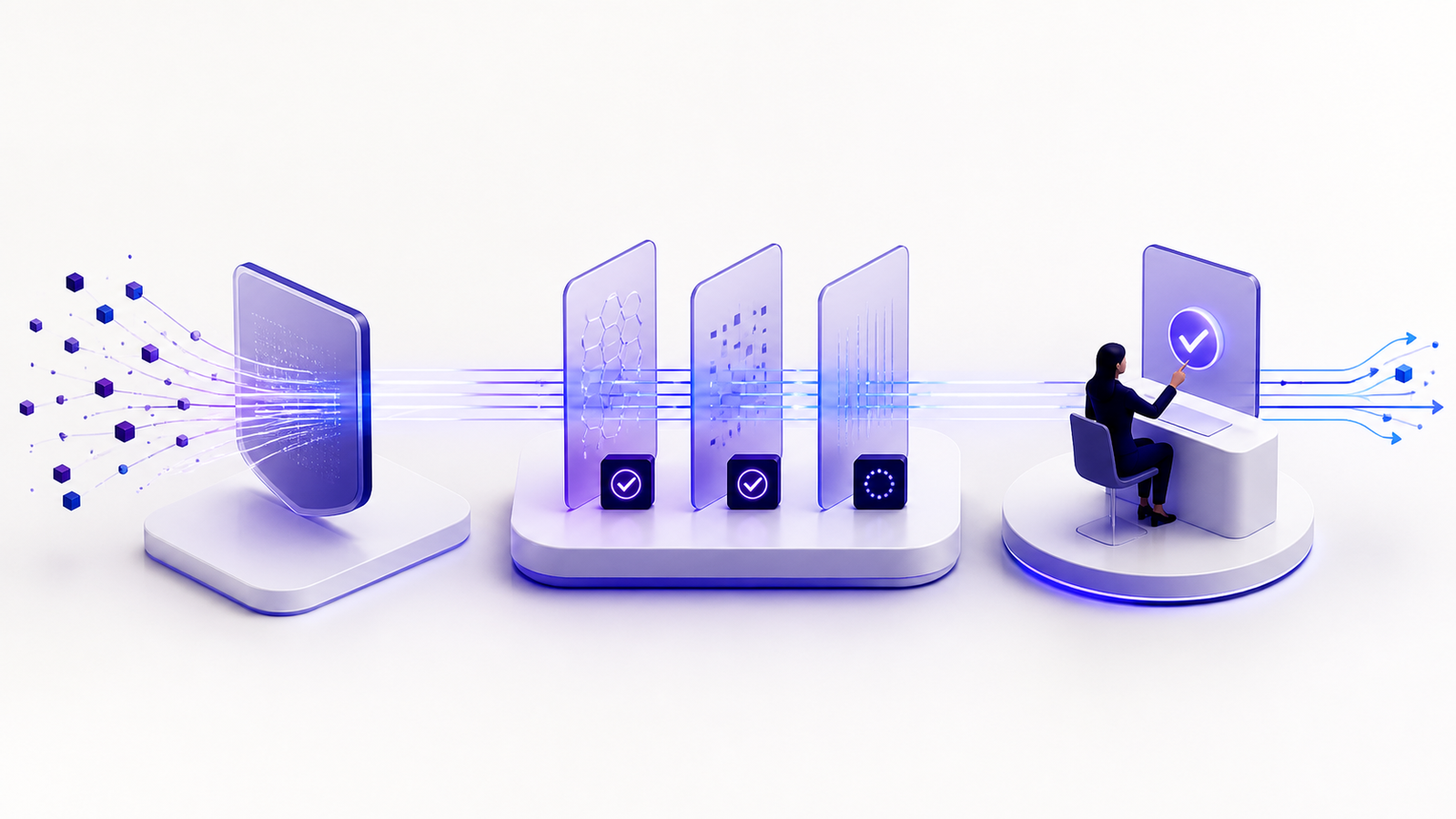
A practical implementation begins with the control plane. Identity establishes who is making the request. Policies define which sources and actions are permitted. Model routing ensures tasks go to an appropriate model. Guardrails examine inputs and outputs for policy violations, while evaluation measures whether an answer or action is accurate enough for the workflow. The data plane then supplies only the knowledge that is approved for that user and task, preserving source attribution and reducing unnecessary exposure.
This architecture also improves business performance. Smaller, bounded agents are easier to test, easier to audit, and less expensive to operate. Human approval can be retained for consequential actions while routine work is automated. Teams can improve a workflow through real evidence—quality scores, escalations, latency, and business outcomes—rather than assuming that more autonomy is always better.
The enterprise opportunity is not to avoid agents. It is to deploy them with the same discipline used for identity, data, and operational controls. Neurovians helps organisations define the boundaries, connect approved knowledge, evaluate behaviour, and create safe paths from recommendation to action. The result is useful automation that earns trust rather than asking the organisation to accept unnecessary risk.